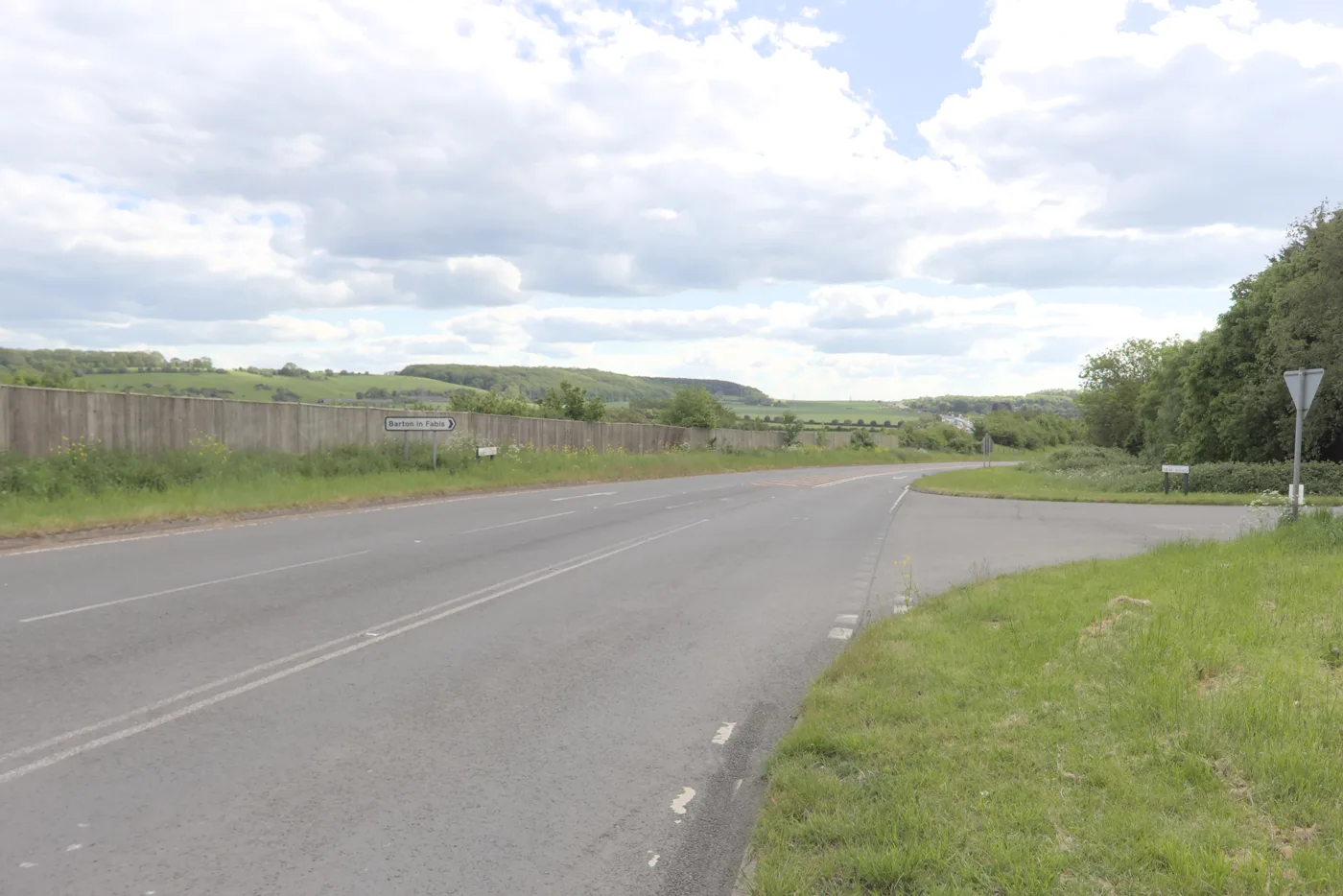

Nottingham councillors are asked on 23 September to back the 85-hectare quarry, after 1,431 objections and the county's refusal. A public inquiry decides it.
Nottingham City councillors are being asked on Wednesday to say they would have approved the Barton in Fabis sand and gravel quarry, nine months after Nottinghamshire County Council refused it.
They cannot actually grant it. The applicant appealed in July, so the decision has already passed to a planning inspector. The meeting is about what position the city takes to the public inquiry that follows.
The site is about five miles south west of West Bridgford, on land off Green Street at Mill Hill and off Chestnut Lane at Barton in Fabis.
Planning Committee meets at 2pm on Wednesday 23 September at Loxley House, Station Street. The quarry is item 4a. (Nottingham City Council, agenda)
What is proposed
The application is by PDE Consulting Ltd for Land Logical Ltd. It covers 85.15 hectares straddling the city and county boundary, and it would take:
- 2.55 million tonnes of sand and gravel in total
- 280,000 tonnes a year at the proposed output rate
- over 10 years of extraction, or about 12.5 years including set-up and clearance
- with restoration finished in 15 years and a 30-year aftercare plan
Only 10.7 hectares, roughly 12% of the site, sits inside the city boundary. That parcel is the final extraction phase and holds under 20% of the mineral. No access, plant, conveyor, weighbridge or stockpiles would be built on it. The officer report is blunt that the city land “could not operate as a standalone mineral site”. (Nottingham City Council, officer report)
Most of the site was allocated for minerals as site MP2p in the Nottinghamshire Minerals Local Plan, adopted on 25 March 2021. An earlier pair of applications for 1.85 million tonnes at the same place was withdrawn in March 2022 before any decision.
The traffic is the part residents feel
All quarry traffic would use a new priority junction on Green Street, about 180 metres south west of the Mill Hill roundabout, then the A453. The report puts the figures at:
- 51 HGV loads a day, which is 102 two-way lorry movements
- around 10 lorry movements an hour while the quarry is working
- 07:00 to 18:00 Monday to Friday, 07:00 to 13:00 on Saturdays
- about 16 employees on site
On the A453 itself that is calculated as 0.2% to 0.3% of all traffic, and 2.4% to 2.9% of lorries. National Highways, the county and the city highway authority all raised no objection on capacity grounds.
Why the county said no
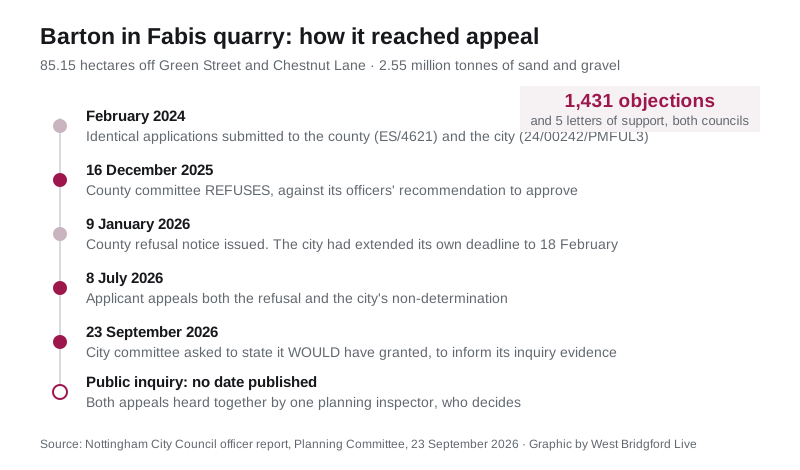
Nottinghamshire County Council’s Planning and Rights of Way Committee refused the larger county application on 16 December 2025, against its own officers’ recommendation to approve. The decision notice went out on 9 January 2026. It gave two reasons:
- the conveyor, haul road and associated infrastructure would cause unacceptable landscape and visual harm, including to people using the footpath and bridleway network, and that harm was not outweighed by any current need
- uncertainty remained over ecological effects, including on Holme Pit Site of Special Scientific Interest, the loss of parts of the Brandshill Grassland and Brandshill Marsh Local Wildlife Sites, and impacts on protected species including barn owl
The city never reached a vote. It had agreed to wait for the county and extended its own deadline to 18 February 2026. On 8 July 2026 the applicant appealed both the county’s refusal and the city’s failure to decide.
The objections, counted
Across every round of consultation the two councils logged:
| Objections | Support | |
|---|---|---|
| Nottinghamshire County Council | about 1,333 | 4 |
| Nottingham City Council | about 98 | 1 |
Rushcliffe Borough Council objected, calling the plant, conveyor, offices and parking inappropriate development in the Green Belt. Broxtowe Borough Council did not object.
Objections were also lodged by both MPs covering the area, James Naish (Rushcliffe) and Lilian Greenwood (Nottingham South), by County Councillor Andy Brown and City Councillor Andrew Rule, and by the SAVE campaign on behalf of five parish councils: Barton in Fabis, Gotham, Thrumpton, Kingston on Soar and Ratcliffe on Soar. Nottinghamshire Wildlife Trust, the Holme Pit Action Group and the Rushcliffe Barn Owl Project all objected.
The statutory consultees did not. The Environment Agency, Natural England, Historic England, National Highways, the Canal and River Trust, East Midlands Airport, the Health and Safety Executive and the UK Health Security Agency each raised no objection subject to conditions.
Dust, noise and Lark Hill
Residents raised silica dust and health effects, particularly for Lark Hill Retirement Village at Clifton. The environmental statement concluded the impacts on nearby communities would not be significant, with a dust management plan, water suppression, wheel washing, road sweeping and real-time air quality monitoring. The UK Health Security Agency did not object.
On noise, the report says predicted levels at nearby homes would stay within accepted limits. It accepts the change is real for people out walking: the most noticeable effects would fall on users of Bridleway BW3 and a diverted section of Footpath FP2, where the quarry and the conveyor crossing would be both seen and heard.
The argument officers make
Officers recommend the committee resolve that it would have granted permission. Their reasoning, in short:
- mineral extraction is not inappropriate development in the Green Belt, and this parcel would have minimal effect on openness
- national policy gives substantial weight to the benefits of mineral extraction
- the harms identified are largely temporary and can be handled by planning conditions
- restoration would deliver habitat creation, public access and wetland
The need case is the weakest link and the report does not hide it. Nottinghamshire’s plan assumes 32.2 million tonnes of aggregate between 2021 and 2036. The latest Local Aggregate Assessment, from December 2025, puts the ten-year sales average at about 1.24 million tonnes a year and the landbank at more than 15 years, against a national minimum of seven. The report answers that the minimum is a floor rather than a ceiling, and that supply serving the Nottingham market has shrunk as older quarries closed.
What happens next, and what it costs
The inspector decides, not either council. The Planning Inspectorate has confirmed the appeals will be heard together at a single public inquiry.
No inquiry date has been published. The SAVE campaign, which is organising the objectors, says on its own site that it expects an inquiry lasting 8 to 12 days, starting roughly 12 to 16 weeks after an inspector is appointed, and that this could mean late 2026 or early 2027. It has not been told a date either. (SAVE campaign)
The city’s report also warns that taking part will cost money. It lists officer time, external legal support “including the possible appointment of barrister”, specialist advice, preparing appeal documents and attending the inquiry. No figure is given, because the cost depends on how far the council pushes its case.
What it means for you
If you objected already, your objection still counts. Representations made to either council are passed to the inspector, so you do not need to resubmit them.
- To watch Wednesday’s meeting, the city council webcasts Planning Committee from Loxley House, and the papers are already public.
- To follow the appeal, the case file is on the city’s planning register under reference 24/00242/PMFUL3, where the status currently reads “awaiting decision” with an appeal lodged. The county reference is ES/4621, and its Rushcliffe reference is 8/24/00388/CMA.
- To make a new representation, wait for the inspector to be appointed. Written submissions to an inquiry have their own deadline, set by the Planning Inspectorate, and it has not been set yet.
- If you live on the Green Street or A453 side, the traffic numbers above are the ones to argue with. They rest on an output of 280,000 tonnes a year.
The applicant sets out its own case at fabisquarry.com, which describes a shorter timespan of up to 12.5 years and a smaller extraction area than the withdrawn 2017 scheme. That site carries nothing about the appeal.
We track Rushcliffe’s own applications on our West Bridgford planning news page, and current closures on the roadworks and travel page.
Sources
- Nottingham City Council, Planning Committee agenda, 23 September 2026
- Nottingham City Council, officer report on 24/00242/PMFUL3
- Nottingham City Council, planning register entry for 24/00242/PMFUL3
- SAVE campaign and Fabis Quarry, the applicant’s site
Update, 27 September 2026: the committee voted against the officer recommendation on 23 September, so the city will oppose the quarry at the inquiry. Its reasons come back to a later meeting. Our report on the vote.
Have your say