

From 31 October most Rushcliffe planning applications must be decided by officers. Councillors can still refer, but two named people must both agree first.
From 31 October, the way a planning application in Rushcliffe reaches a public hearing changes, and for a large class of applications it stops being possible at all.
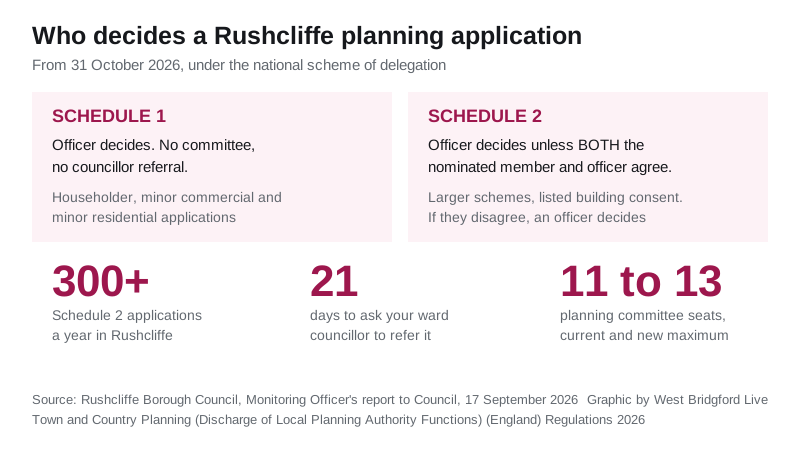
New national regulations sort every application into two lists. One list must be decided by a council officer, with no route to committee. The other goes to an officer by default, and reaches the planning committee only if two named people both agree that it should.
Councillors vote on the constitutional changes at full council on Thursday 17 September. They have little choice: the Monitoring Officer’s report says the council must comply by 31 October or risk decisions being challenged by judicial review.
Who the two people are
The regulations require each council to appoint a “Nominated Member” and a “Nominated Officer”. Rushcliffe proposes:
- Nominated Member: the Chair of the Planning Committee, currently Councillor Rex Walker
- Nominated Officer: the Assistant Director of Planning
They apply what the regulations call the Gateway Test. An application passes only if it raises either “one or more issues of economic social or environmental significance to the local area”, or “one or more significant planning matters” under the development plan.
The detail that matters is what happens when they disagree. The report is explicit: “If both agree the test is passed the application will go to committee. If they cannot agree then the application will be determined by an officer.” There is no casting vote and no appeal. A tie means no public hearing.
Those refusals do have to be written down. The report says the decisions “require to be documented and presented to planning committee by way of an update report”, so the committee will be told afterwards what it was not asked to decide.
What councillors can and cannot do now
Rushcliffe is keeping the ward councillor referral route as far as the law allows, but it no longer guarantees anything.
- A ward councillor whose ward covers the site can still request that a Schedule 2 application goes to committee, within the 21-day consultee window.
- That request now goes to the Nominated Member and Nominated Officer for the Gateway Test, rather than straight onto the agenda.
- A ward councillor cannot refer a Schedule 1 application at all. Those must be decided by an officer.
The report gives a sense of the volume involved: Rushcliffe handles “some 300 plus Schedule 2 applications per annum many of which are not referred”.
Which applications are in which list
Schedule 1, officer decision only. No referral, no committee. This is the list most residents actually encounter:
- householder applications
- minor commercial applications
- minor residential applications
- certificates of lawful use or development, existing and proposed
- permission in principle
- non-material amendments under section 96A
- prior approval applications
- reserved matters on an outline permission, unless it is a large outline permission
- biodiversity gain plans
Schedule 2, officer by default unless the Gateway Test is passed. This is where the bigger schemes sit:
- listed building consent, and variation or discharge of its conditions
- any planning application that is not a householder, minor commercial or minor residential application
- section 73 applications where the original permission was itself a Schedule 2 permission
Applications made by the council itself, or by one of its members or officers, get a separate route. These “own-interest” applications can be sent straight to committee by the two nominated people, for reasons such as potential bias or transparency, without going through the Gateway Test at all. (Rushcliffe Borough Council, Monitoring Officer’s report)
A bigger committee
One change goes the other way. The constitution is being amended so that no more than 13 members may sit on the planning committee. Rushcliffe currently has 11, so the cap is a ceiling it has room under rather than a cut. (Rushcliffe Borough Council, Planning Committee membership)
The applications already in the queue
The report addresses this in a single sentence, and it is worth reading closely: “There are currently some applications that are in train that are not in accordance with the national scheme and the intention is that they will conclude by 31 October 2026.”
That is an intention, not a guarantee, and the report does not say which applications it means or what happens to any that slip. The council’s next planning committee is on 16 September, when it considers Nottingham Forest’s City Ground expansion.
Where the rules come from
This is not a Rushcliffe decision. The Town and Country Planning (Discharge of Local Planning Authority Functions) (England) Regulations 2026 were published in June 2026 and come into force on 31 October, and they apply to every local planning authority in England. The Government’s own guidance sits alongside them.
The report notes that failure to implement would leave the council “acting unlawfully” and could expose decisions to judicial review or a complaint to the Local Government Ombudsman.
Reorganisation does not change this. The report says that even with the Structural Changes Order not yet issued and the process paused, the amendments “are mandated by legislation in any event”. (MHCLG statutory guidance)
One loose end in the papers: the report names the Assistant Director of Planning as the Nominated Officer, while the constitution text it amends refers throughout to the Director for Growth and Economic Development as the person exercising delegated authority, and uses several variations of that job title. The papers do not reconcile the two.
What it means for you
If you object to a neighbour’s extension, a change of use on your street or a small housing scheme, the practical effect is that from 31 October there is no committee to appeal to. Your objection still counts, but it is weighed by a planning officer, and that is the end of the council’s process. Writing a good objection on planning grounds matters more than it did, because there is no second hearing behind it.
For anything larger, the window is tight and the route is indirect. Contact your ward councillor within the 21-day consultation period on the application, and make the case in the terms the Gateway Test uses: significance to the local area, or a significant planning matter under the development plan. A referral asking for a hearing because feelings are strong locally now has somewhere to fail that it did not have before.
You can check what has been submitted near you on our West Bridgford planning page, and Thursday’s meeting at Rushcliffe Arena is open to the public.
Have your say